
I've had the same conversation with six different payment heads this quarter. Each one started with the same question: "Should we go hybrid or structured?" And each time, I had the same reaction: that's not the right question and the industry is spending billions answering it anyway. I've watched this pattern before. Over 30 years in payments technology, I've seen batch-versus-real-time, on-prem-versus-cloud, SWIFT FIN-versus-ISO 20022 messaging. In every case, the "easier" option turned out to require the same fundamental engineering work. The only thing that differed was the ambition of the output. The ISO 20022 compliance debate around structured versus hybrid addressing is no different. Both approaches require the same integration pipeline, the same sidecar architecture, and the same 10–16 week deployment. The only variable is the output configuration and that's a policy setting, not an engineering decision. Choosing hybrid-only is paying full price for a fraction of the value. In this article, I'll show you the architecture, the ten dimensions where structured outperforms hybrid, and a decision framework that settles this debate.
Both Paths Run Through the Same Pipeline
There's a widespread assumption that structured ISO 20022 address implementation is substantially harder than hybrid. It isn't. Here's why.
Any address resolution implementation regardless of whether the target output is hybrid or structured executes the same five stages:
- Ingest. Accept any format input: unstructured free-text, partially structured fields, mixed scripts, financial identifiers embedded in address lines.
- Parse. Decompose the input into discrete components street name, building number, city, postal code, country, sub-division. This is computational linguistics work, not simple string splitting.
- Validate. Confirm each component against reference data postal authority databases, country-specific format rules, ISO 3166 country codes.
- Enrich. Disambiguate (which of 28 cities named Paris?), resolve historical street names, preserve financial identifiers like LEI, IBAN, and BIC that legacy systems frequently embed in address fields. This is the layer that separates payment-grade address resolution from generic postal validation.
- Map. Output to the ISO 20022 address format XML schema — either structured or hybrid.
Here's the critical point: stages 1 through 4 are where 95% of the engineering, testing, and integration effort lives. They are identical whether your target output is hybrid or structured.
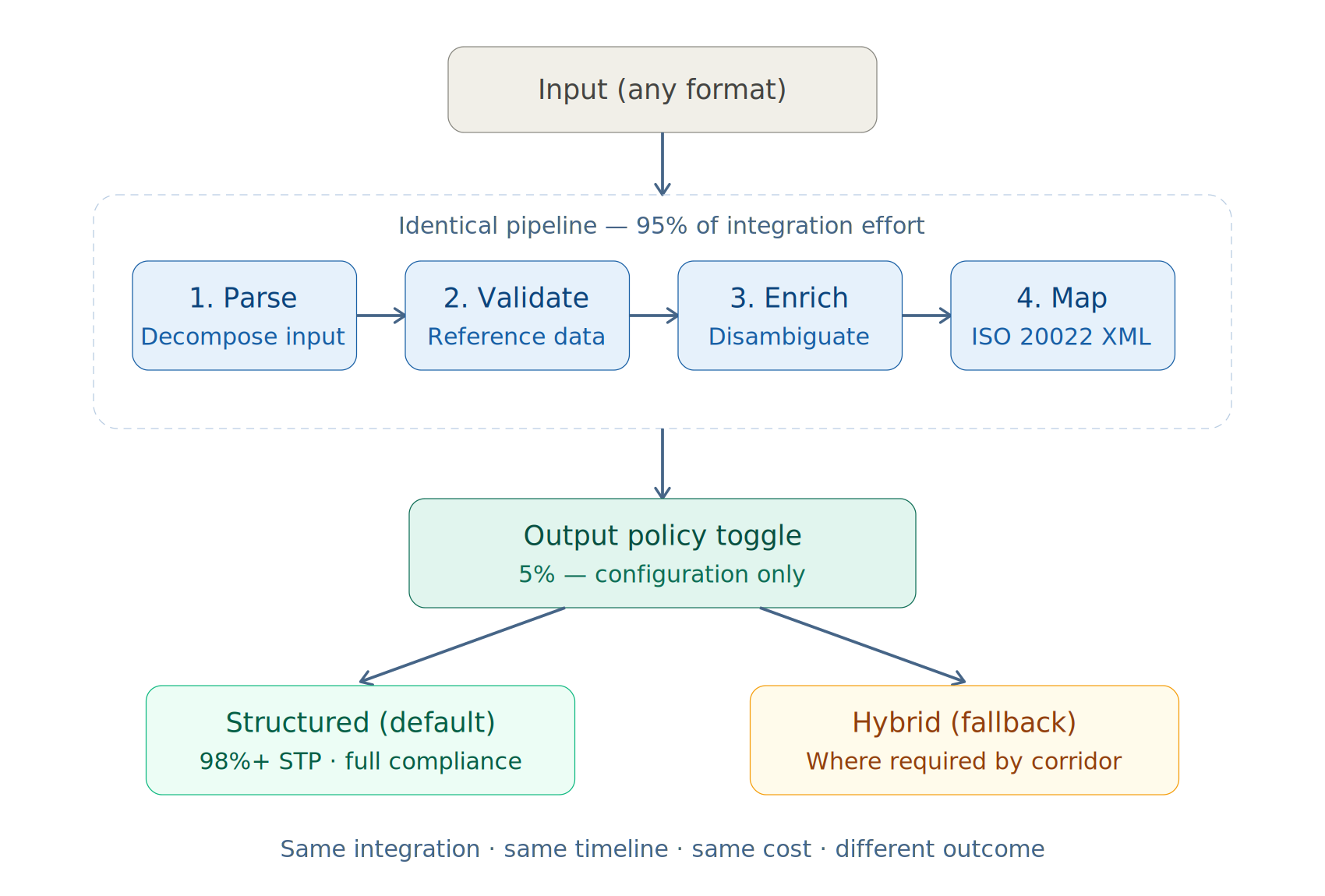
Figure 1: The five-stage address resolution pipeline. Stages 1–4 are identical for both output modes. Only the output policy toggle differs — a configuration setting, not a re-architecture.
If 95% of the effort is shared and the remaining 5% is a configuration setting, the claim that "hybrid is easier to implement" isn't an engineering observation. It's a market misconception.
Three Reasons the Industry Believes Otherwise
When the European Payments Council introduced hybrid as a "transition mechanism" and SWIFT accepted it as a "minimum fallback" for CBPR+, the market interpreted "transition" and "minimum" as "simpler." That's a category error confusing regulatory acceptance floors with engineering complexity. Three factors reinforced it.
First, vendor framing. Generic postal address validators marketed hybrid output as their maximum capability because postal validation is their maximum capability. They framed it as "sufficient" because they couldn't offer more.
Second, risk-aversion culture. "Minimum viable compliance" became the default posture in payment operations. Meet the floor, worry about the ceiling later. But in this case, the floor and the ceiling require the same staircase. The implementation work for structured and hybrid is identical same pipeline, same sidecar integration, same timeline.
Third, the naming problem. "Hybrid" sounds modern and pragmatic. "Structured" sounds rigid and demanding. I've watched the industry make naming-driven decisions for three decades. We chose "digital transformation" over "systems modernisation" for the same reason — the label sold better, even when the work was identical.
The PMPG's own documentation reveals what happens in practice: TwnNm fields left blank, Country codes duplicated inside AdrLine, three AddressLines submitted where only two are permitted. The effort wasn't saved — it was misallocated.
Structured is the superset. Hybrid is the subset. Delivering structured automatically satisfies hybrid requirements. The reverse is not true.
Want weekly analysis like this? Subscribe to Resolved my newsletter on address intelligence and payment compliance.
Ten Dimensions Where Structured Outperforms Hybrid
Once you accept that the implementation effort is equivalent, the next question is obvious: what's the difference in outcomes? The answer isn't a marginal improvement across one or two metrics. It's a transformational advantage across every dimension that matters to a financial institution.
Institutions that treat address structuring as a pure compliance exercise capture less than 20% of the available value. Here are the ten dimensions where structured delivers and hybrid doesn't.
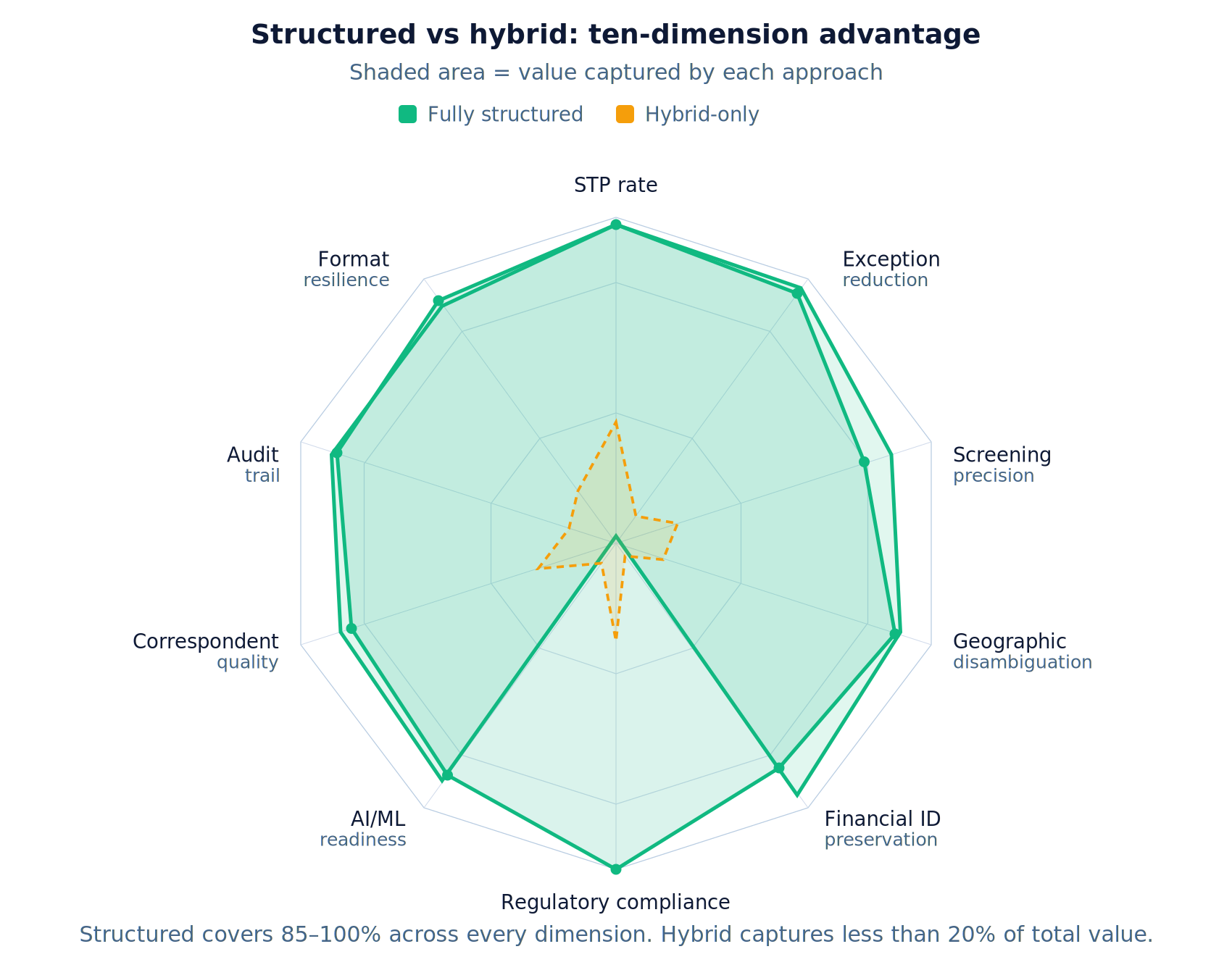
Figure 2: Radar chart showing the multi-dimensional advantage of structured (green) versus hybrid (amber). Structured covers 85–100% across every dimension. Hybrid captures less than 20% of total value.
Operations and economics
Straight-through processing. The industry cross-border STP baseline sits at roughly 25–40% — meaning 60–75% of cross-border payments require some form of manual intervention. That's the number from operational data, not the 60–90% that AI models and some industry reports frequently cite. Hybrid addressing improves STP by a marginal 5–15 percentage points. Structured addressing targets 98%+ STP, because every address component is discretely validated before the payment enters the correspondent banking chain.
Exception economics. At $25–50 per exception and 60% exception rates under hybrid-only, a mid-size bank processing 5 million monthly transactions spends $15–25M annually on address-related exceptions. Structured resolution reduces exception rates to below 2%, saving $13–23M per year. Same integration investment. 30–50× ROI difference.
Format conversion resilience. When payment messages traverse format conversions — MT to MX, SEPA to CBPR+ — free-text AdrLine content is frequently truncated or re-parsed incorrectly. Structured data survives these transformations intact because semantic meaning is encoded in the XML structure itself.
Compliance and governance
Regulatory compliance level. EPC, SWIFT CBPR+, and CPMI/BIS all designate fully structured as the regulatory objective. Hybrid is explicitly the "allowed minimum fallback." Structured satisfies current mandates and positions institutions for the EPC E&I requirements tightening in 2027.
Sanctions screening precision. This is the "Cuba Street" problem: unstructured address strings trigger false positives when screening engines can't distinguish street names from sanctioned jurisdictions. Structured addresses with a discrete Country field enable field-level screening — reducing false positives by 25–30%, recovering thousands of compliance analyst hours annually.
Audit trail and provenance. Hybrid output provides minimal traceability. Structured resolution provides full deterministic provenance: every component mapped, validated, and enriched with an auditable transformation record. When the regulator asks "how did you determine the country for this payment?", structured provides a documented answer
Data quality and intelligence
Geographic disambiguation. 28 cities are named Paris. 17 are named London. Hybrid's limited AdrLine fields lack the granularity for multi-signal disambiguation. Structured fields enable postal format analysis, street convention matching, and correspondent pattern correlation to resolve to the correct city at origin.
Financial ID preservation. Legacy systems routinely embed LEI, IBAN, BIC, and SWIFT codes inside address fields. Hybrid parsing cannot reliably distinguish these from address text. Structured resolution validates and preserves 50+ financial identifier types before address decomposition begins, preventing data loss that triggers compliance alerts.
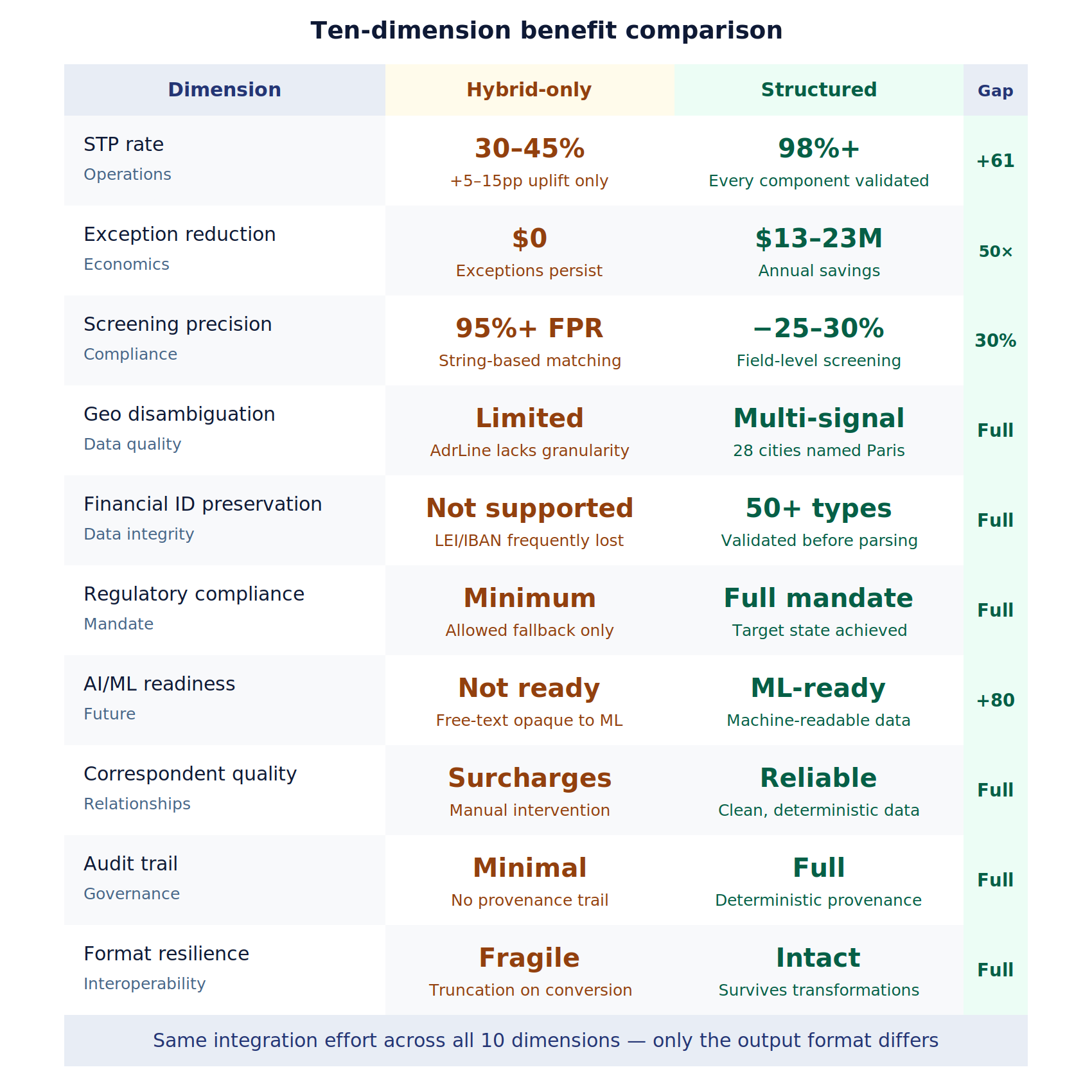
Figure 3: Ten-dimension benefit comparison. Structured outperforms hybrid across every metric — with identical integration effort.
Strategic and future readiness
AI and automation readiness. 30–40% of AI model failures in financial services trace to data quality issues. Structured addresses create the machine-readable, consistently formatted data foundation that every bank needs for next-generation automation. Institutions starting with structured data are 12–18 months ahead.
Correspondent banking quality. Correspondent banks receiving poorly structured data impose surcharges, restrict corridors, or require manual intervention. Structured data improves these relationships by delivering clean, deterministic, standards-compliant data. In a market where correspondent relationships are consolidating, data quality is a competitive differentiator.
The compounding effect
These ten dimensions don't operate in isolation. Higher STP leads to fewer exceptions, which lowers cost, which enables better screening, which produces cleaner data, which improves correspondent relationships, which accelerates AI readiness. Each outcome reinforces the others. Hybrid-only captures the first rung. Structured captures the full cascade. Same effort in. Radically different results out.
Why "Hybrid Now, Structured Later" Costs More Than Doing It Once
I've seen this playbook before. In every previous technology cycle — SEPA migration, real-time payments, SWIFT gpi — the "we'll upgrade later" cohort ended up spending more than the institutions that built to the target state from the beginning.
Structured now means one project, one integration cycle, one budget approval. Hybrid fallback is included automatically — the platform's output policy handles corridor-specific requirements without additional work. You build once, deploy fully.
Hybrid now, structured later means two projects. Two budget approvals. Two testing cycles. Organisational re-mobilisation. The "later" project typically costs 60–80% of the original — not the "small configuration change" that stakeholders assume.
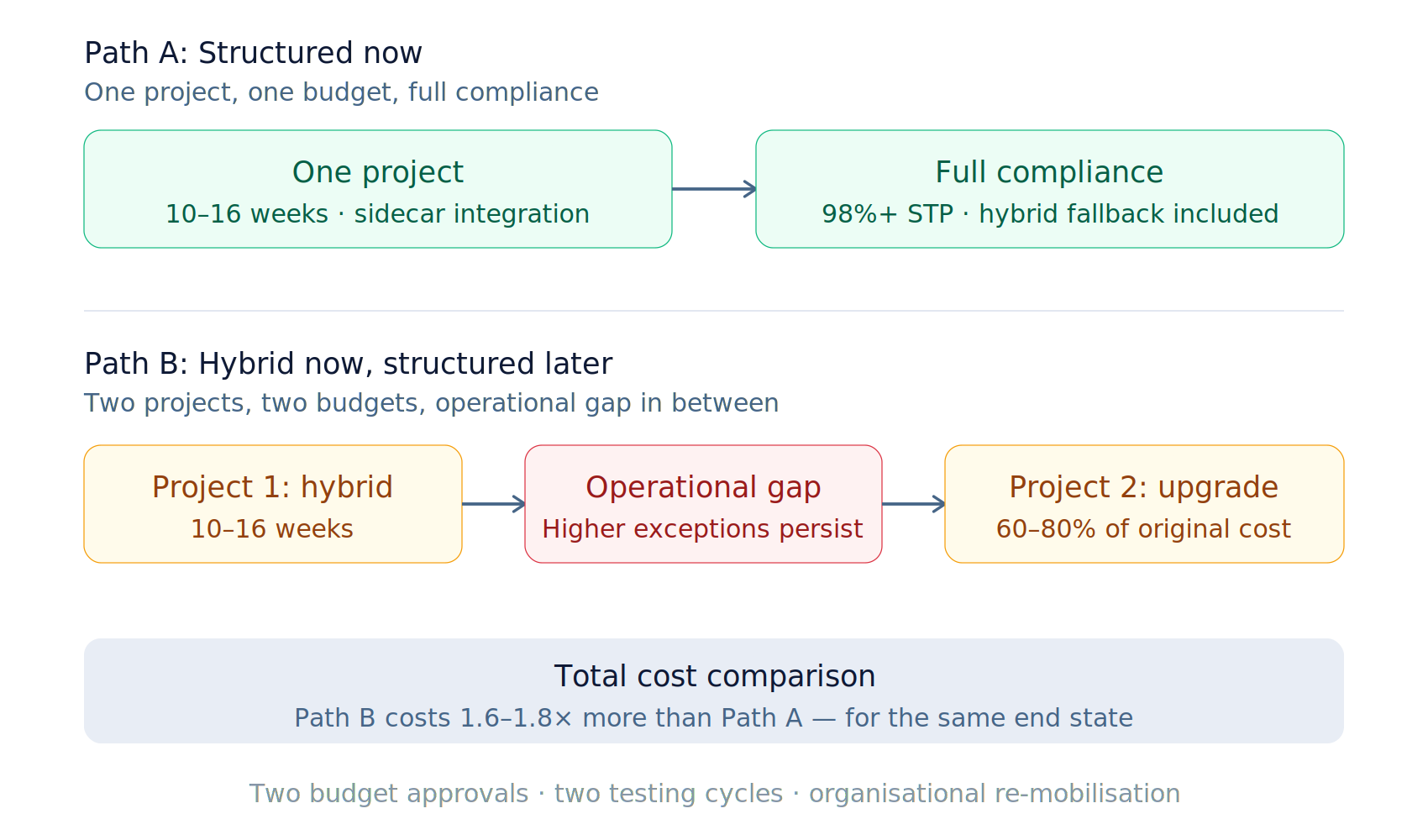
Figure 4: Path A (structured now) is one project to full compliance. Path B (hybrid now, structured later) costs 1.6–1.8× more for the same end state.
It's like building a house with plumbing for two bathrooms but only connecting one because the second one "can wait." The pipes are already laid. The effort is connecting them. Why leave money on the table?
The Decision Framework for Your Next Steering Committee
If you take one thing from this article, take these three questions into your next meeting. They settle the debate.
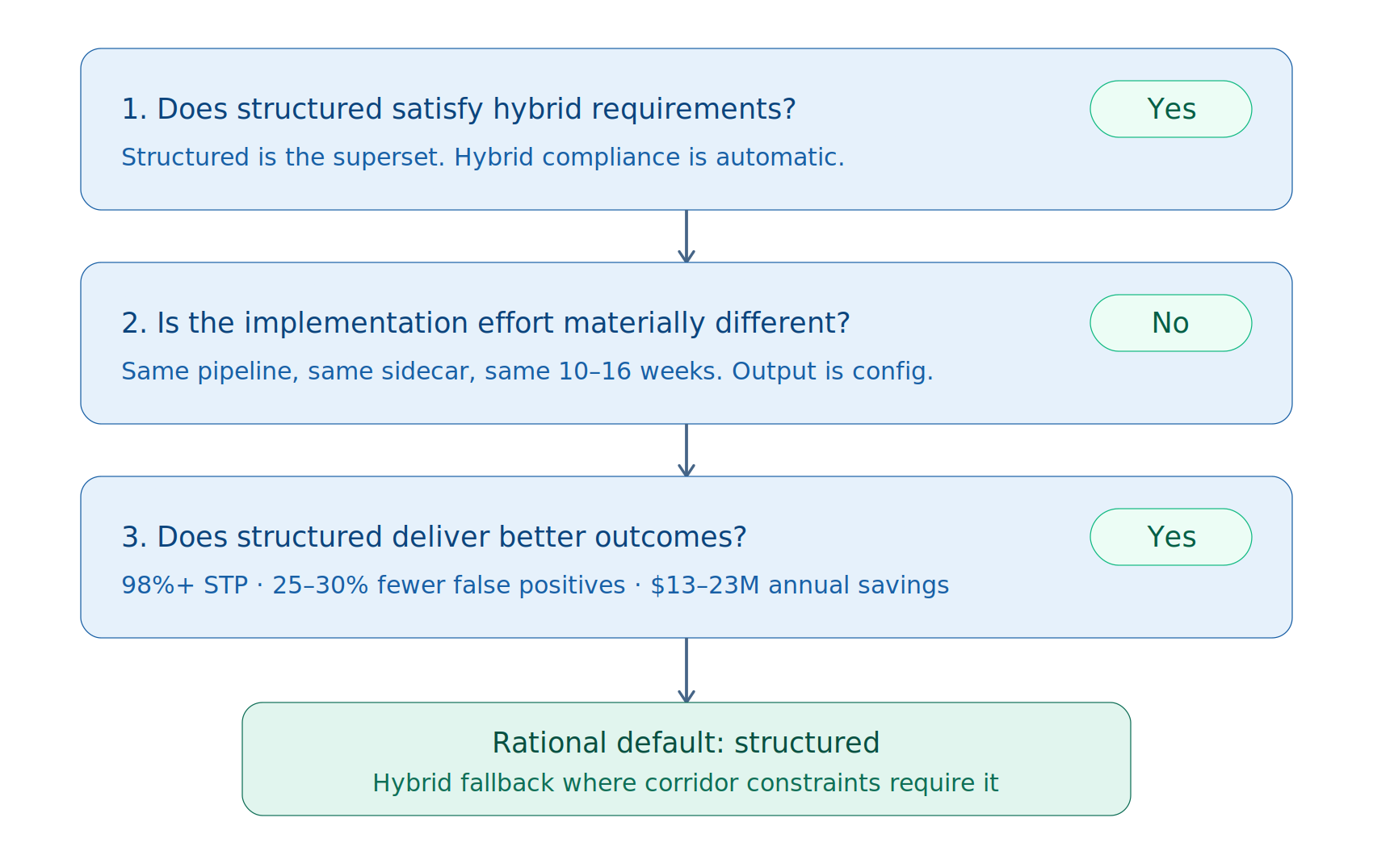
Figure 5: Three questions that settle the structured-vs-hybrid debate. All three answers point to structured as the rational default.
If the answer to all three is yes and the evidence says it is the rational default is structured. The one legitimate exception: specific corridors where a correspondent bank cannot yet accept structured format. That's exactly what the automatic hybrid fallback mechanism exists for. Structured by default. Hybrid where operationally necessary.
The question was never "hybrid or structured?" The question is: why would you choose the inferior outcome when the effort is the same?
What's Your Next Step?
See the pipeline. Book a demo to watch the five-stage pipeline process your institution's real address data live.
Stay informed. Subscribe to Resolved, my weekly newsletter on address intelligence, ISO 20022 compliance, and payment operations.
Frequently Asked Questions
Key Takeaways
- 1 Same pipeline, different output — structured and hybrid require the same five-stage implementation. Only the output format differs.
- 2 Output format is a configuration setting — not an architecture change. 10–16 weeks via sidecar. No core system replacement. Identical for both modes.
- 3 Structured outperforms across all ten dimensions — operations, economics, compliance, screening, disambiguation, financial ID preservation, audit, AI readiness, correspondent quality, and format resilience.
- 4 Less than 20% of value captured — institutions treating structured as "just compliance" leave the remaining 80% on the table.
- 5 Hybrid-only means a second project — when structured mandates tighten in 2027, hybrid-only institutions will pay for migration twice.
- 6 Structured is the superset — delivering structured automatically satisfies hybrid requirements. The reverse is not true.
- 7 Structured by default, hybrid where necessary — the rational, future-proof choice for every institution entering the November 2026 deadline.
Parth writes about the intersection of AI, payments compliance, and data intelligence. With 30 years in financial services technology, he focuses on the implementation details that separate compliant institutions from those still chasing deadlines. About ioNova →